● unCozy Islands - ARCH 511-611 - Fall 2024 - Sam Fox School of Design and Visual Arts - Washington University in St. Louis
unCozy Islands. Mixed-Used Experiments in Food-Productive Landscapes. F24.
↓ Studio Description.
Pastoral music and literature from the 17th century shaped modern ideas about the countryside. These art forms celebrated the peaceful, comfortable, simple rural life instead of the busy urban lifestyle. They highlighted the close connection between humans and nature, portraying tranquil scenes of people and animals living harmoniously amidst neoclassical architecture. However, this idealized view of rural landscapes is unrealistic and continues to influence our culture today.
During the Industrial Revolution, as people migrated to cities, architects focused on addressing urban issues. This emphasis on cities led to neglect of rural development, which has created an imbalance in architectural conversations that persists today. The production of food is predominantly controlled by large agribusiness corporations or small family-run operations. This has resulted in unequal distribution and social challenges related to institutions and infrastructure.
Agricultural communities are currently grappling with two major challenges: an aging population and the necessity for younger generations to take a greater interest in agriculture. This studio is committed to offering creative solutions for these challenges and motivating architects and designers to take into account rural areas. The project is inspired by the architectural innovations of Charles Fourier, Claude Ledoux, and Robert Owen, who were associated with Utopian Socialism in the late 18th century.
These designs showcase the programmatic coexistence of education, production, health, leisure, and housing. The objective is to create a mixed-use building that will house an agricultural school, a daycare center for the elderly, and leisure facilities, all connected to a food product associated with each site. The program will be consistent for all students, but the locations and material systems linked to those sites will vary significantly. The Options Studio is divided into five fundamental tastes: sweet, sour, bitter, salty, and umami.
Each student will delve into a different food product that has had a significant impact on the region where it is produced. For example, these products include tea from the Black Sea region, sugar beets from Japan, halibut from Greenland, wine from Pico Island in the Azores, and rye and barley from Poland. Fourteen food products and their respective farming sites have already been chosen, encompassing countries such as Indonesia, Japan, Spain, France, and the Philippines. Students will be assigned specific local building materials based on the site where they will work, the particular food product, the farming community, and the location.
While other materials and solutions are allowed, at least part of the solution must recognize and respect the site’s local and historical building constraints. Some examples of these materials include half-timber framing in Turkey, volcanic stone construction in the Azores, rammed earth design in Bolivia, and latticework and domes used by Mongolian herders.
Even though all projects may appear to be addressing the same issue, the varying climatic conditions, economic circumstances, and material limitations will foster a broad discussion about architecture and design. The studio’s structure will encourage participants to learn not only from their own assignments but also from their fellow students’ experiences.
Students:
During the Industrial Revolution, as people migrated to cities, architects focused on addressing urban issues. This emphasis on cities led to neglect of rural development, which has created an imbalance in architectural conversations that persists today. The production of food is predominantly controlled by large agribusiness corporations or small family-run operations. This has resulted in unequal distribution and social challenges related to institutions and infrastructure.
Agricultural communities are currently grappling with two major challenges: an aging population and the necessity for younger generations to take a greater interest in agriculture. This studio is committed to offering creative solutions for these challenges and motivating architects and designers to take into account rural areas. The project is inspired by the architectural innovations of Charles Fourier, Claude Ledoux, and Robert Owen, who were associated with Utopian Socialism in the late 18th century.
These designs showcase the programmatic coexistence of education, production, health, leisure, and housing. The objective is to create a mixed-use building that will house an agricultural school, a daycare center for the elderly, and leisure facilities, all connected to a food product associated with each site. The program will be consistent for all students, but the locations and material systems linked to those sites will vary significantly. The Options Studio is divided into five fundamental tastes: sweet, sour, bitter, salty, and umami.
Each student will delve into a different food product that has had a significant impact on the region where it is produced. For example, these products include tea from the Black Sea region, sugar beets from Japan, halibut from Greenland, wine from Pico Island in the Azores, and rye and barley from Poland. Fourteen food products and their respective farming sites have already been chosen, encompassing countries such as Indonesia, Japan, Spain, France, and the Philippines. Students will be assigned specific local building materials based on the site where they will work, the particular food product, the farming community, and the location.
While other materials and solutions are allowed, at least part of the solution must recognize and respect the site’s local and historical building constraints. Some examples of these materials include half-timber framing in Turkey, volcanic stone construction in the Azores, rammed earth design in Bolivia, and latticework and domes used by Mongolian herders.
Even though all projects may appear to be addressing the same issue, the varying climatic conditions, economic circumstances, and material limitations will foster a broad discussion about architecture and design. The studio’s structure will encourage participants to learn not only from their own assignments but also from their fellow students’ experiences.
Students:
● A selection of images and student work from the studio
Thirteen Food Products.
Same Program.
Different
Communities and Locations.


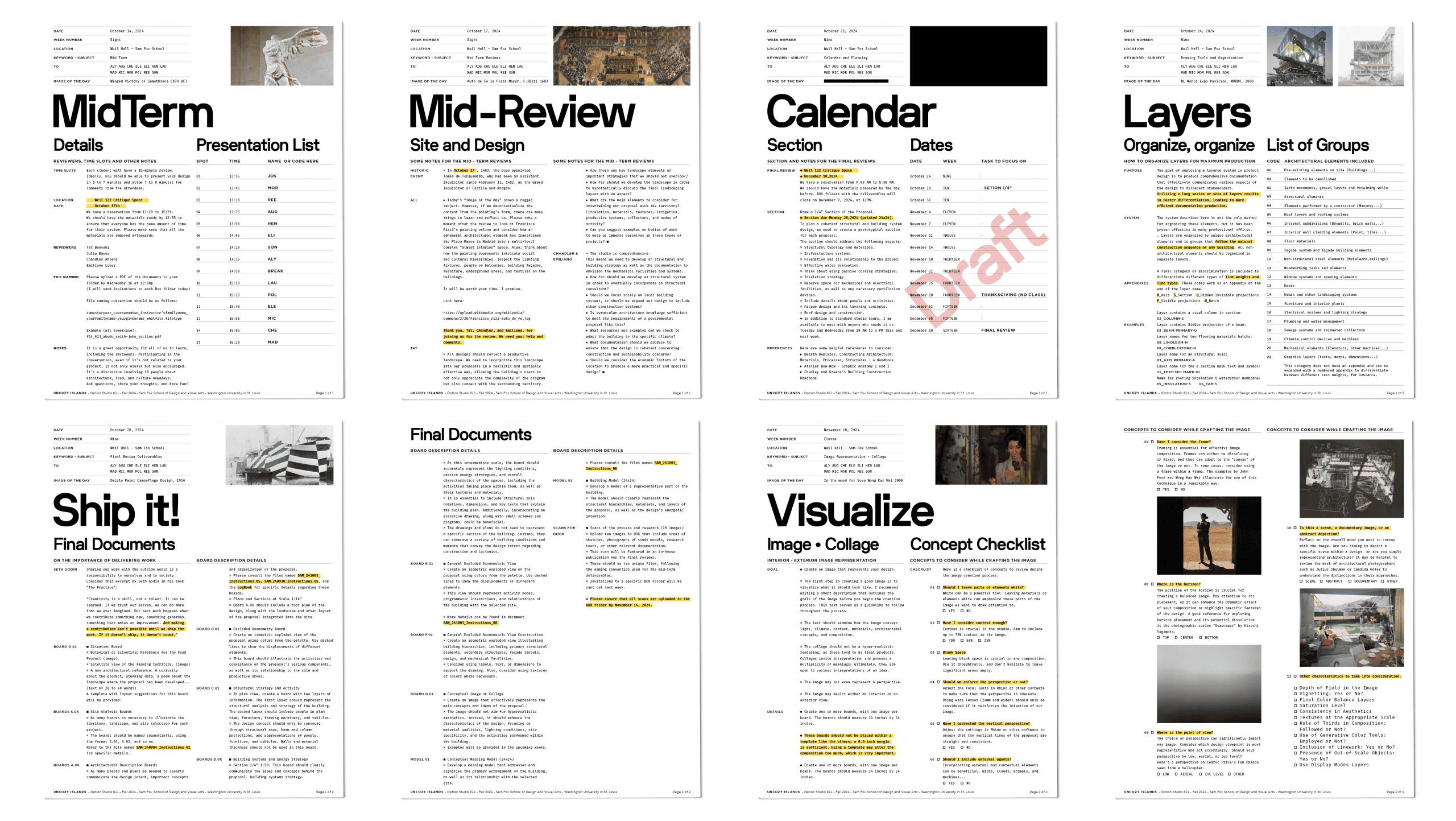
● A set of instructions to guide the course
Weekly Instrucions &
LogBooks.
Each week, we implemented new instructions to advance the project at various scales.
We maintained a logbook to record feedback and ensure our group remained aligned with project objectives.


● Site - Location - GIS Mapping
Site Selection & Analysis
We seek to analyze how various layers of information interact and contribute to the site. Our objective is to develop a comprehensive understanding of each site's cultural and formal structure to inform the selection of an appropriate location for our facility.
The following parameters and suggestions should be considered: climate, wind direction, natural structure, views, built environment, existing activities, history and memory, soft versus hardscapes, axes and spatial patterns, tonality and color palette, land uses, socio-economic data, void versus solid spaces, transportation systems, topography, health facilities, educational facilities, gender distribution, population and density, distances and modular relationships, rainfall and precipitation, sun exposure, and geometry.


● Design - Materiality
Design Layout + Building Systems
Your objective is to develop a programmatic coexistence and represent it using a scaled diagram. Avoid scaling programs linearly. Illustrate discrete and unique components of the program. Indicate the distances and functions of each element. Integrate different components in relation to one another and to the site. Arrange components across various levels of the building.
Include the square footage and all necessary measurements for each component. Arrange these components on the site, taking into account the site's characteristics and each component's specific requirements. Investigate relevant schemes, surface areas, and workflows associated with the program's productive aspects.


● Model - Image - Display
Model & Visualize
Begin by visualizing the intended appearance of the image that will represent the design. Before starting the creation process, write a brief description outlining the image's objectives. This description will serve as a guideline throughout the development process.
The accompanying text should analyze how the image communicates aspects such as light, climate, context, materials, architectural concepts, and composition. The collage should avoid hyper-realistic rendering, which is typically reserved for final presentations. Collages encourage interpretation and support multiple meanings, allowing for diverse conceptual readings. The image does not need to represent a specific perspective and may depict either an interior or exterior view.


